

By: John Robb, CPO, Reach Orthotic & Prosthetic Services
You’ve probably seen it in the news: paraplegics standing upright and walking again with the aid of robotic exoskeleton systems. No longer the make believe flaunt of a science fiction movie, these real-life bionic devices have made their way into the everyday world of modern healthcare. And with the exoskeleton market expected to gain popularity across the globe, multiple vendors are joining in to offer their versions of the latest technology.
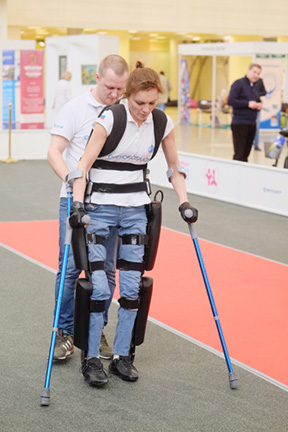 Initially developed for military soldiers in the 1960s by the US armed forces and General Electric, exoskeleton technology is now available to the general population. This modern, wearable technology is a marriage of computer systems and robotics, resulting in a powerful external structure for the human body.
These bionic walking systems utilize a battery, motors and controls that allow wearers to replicate a wide range of movements, detecting and enhancing the user’s own abilities. Spinal cord injury patients may lose all or some of the muscle function in their lower extremities: these devices are secured externally along the lower back and lower extremities, providing movement to the hip, knee and ankle joints similar to normal ambulation. This allows paraplegics to stand up, walk and even climb stairs. Training is needed to learn skills and adapt to the device, and while exoskeletons fall short of normal function, the ongoing technology has a promising future.
Exoskeletons are also extremely helpful in rehabilitation environments, where they provide patients with valuable exercise and therapy treatment options. Physical Therapists can utilize a broad range of parameters for each patient and make adjustments as training progresses.
The Benefits are Widespread:
• Increases physical capabilities and independence
• Offers support for standing, walking, and carrying objects
• Can be utilized for rehabilitation of stroke or spinal cord injury
• Provides mobility which can reduce the disabling effects of some diseases
One of the biggest challenges facing designers of exoskeletons is the power supply. Power sources have to be light enough for the wearer to accommodate, and there are currently only a small number of power sources that can sustain a powered exoskeleton for more than a few hours. With any new technology there is a sizeable price tag, and this carries a hefty one: powered exoskeletons can cost $70,000 or more, and getting insurance coverage is challenging due to lack of long-term outcomes data.
With more and more new players entering the market, the technology continues to advance and evidence of its benefits continues to be collected. In the meantime, we can expect to see more of this technology come off of the big screen and out into the marketplace.